Neural Correlates of Consciousness: Where the Brain Meets the Mind
Looking for Consciousness in the Brain
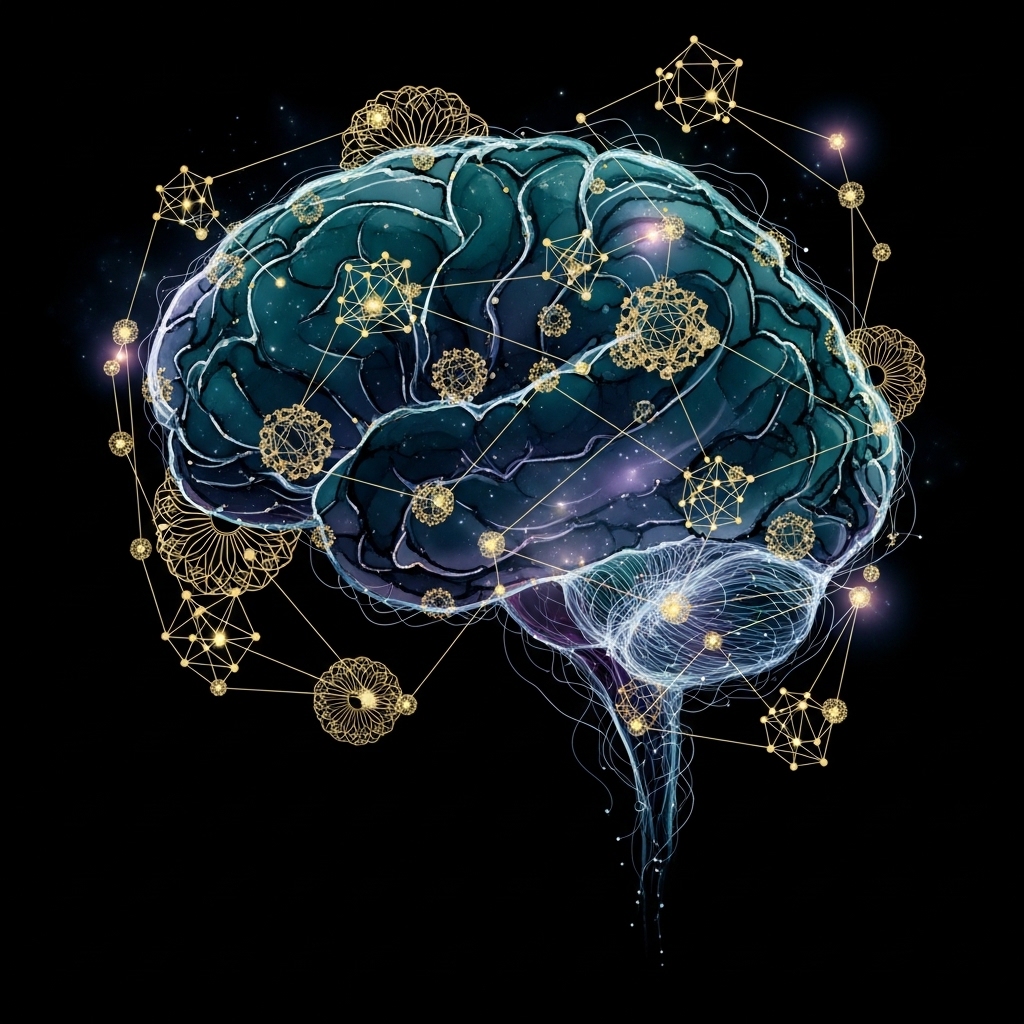
While philosophers debate whether the hard problem of consciousness can ever be solved, neuroscientists have been pursuing a parallel question: can we at least identify the specific brain processes that correlate with, and perhaps cause, conscious experience? The search for the neural correlates of consciousness (NCCs) represents one of the most ambitious empirical projects in modern science -- and after three decades of work, it has produced both remarkable progress and humbling limitations.
What Are Neural Correlates of Consciousness?
The neural correlates of consciousness are defined as the minimal neuronal mechanisms jointly sufficient for any one specific conscious percept -- a definition carefully crafted by Francis Crick (co-discoverer of DNA's structure) and Christof Koch in their pioneering work beginning in 1990.
Note what this definition says and what it does not:
- Minimal: Not the entire brain, not even the entire cortex. The smallest set of neural events that will do the job.
- Jointly sufficient: Together, these mechanisms are enough to produce a conscious experience. Nothing else is needed.
- Any one specific conscious percept: The NCC for seeing red is different from the NCC for hearing a C-sharp. The search is for the neural basis of particular experiences, not "consciousness in general."
The definition also distinguishes between the NCC for the contents of consciousness (what you are conscious of -- seeing a face versus hearing music) and the NCC for the state of consciousness (whether you are conscious at all -- awake versus anesthetized).
The Posterior Cortical Hot Zone
One of the most important findings in NCC research is the identification of a posterior cortical "hot zone" as the primary seat of conscious contents. This region spans the parietal, temporal, and occipital lobes -- roughly the back half of the cortex -- and includes sensory cortices, temporal regions involved in object recognition, and parietal regions involved in spatial representation.
The evidence comes from multiple converging lines:
Lesion studies: Damage to posterior cortical areas produces specific losses of conscious content. Damage to area V4 causes loss of color experience. Damage to the fusiform face area causes loss of face recognition. By contrast, large prefrontal lesions often leave conscious experience remarkably intact.
Direct cortical stimulation: Electrical stimulation of posterior cortical regions during neurosurgery reliably evokes specific conscious experiences -- visual flashes, sounds, tactile sensations, memories. Stimulation of prefrontal cortex rarely produces specific conscious contents.
Neuroimaging: When researchers control for task demands, reporting requirements, and attentional confounds, the neural activity most closely tracking specific conscious contents localizes to posterior cortical areas.
Intracranial recordings: Studies using electrodes implanted in epilepsy patients confirm that content-specific neural activity tracks conscious perception in posterior regions.
The implication: the back of the brain is where the specific contents of experience -- colors, shapes, sounds, textures -- are generated. The front of the brain does important things like planning and self-monitoring, but it does not appear to be where conscious experience itself is created.
The Front vs. Back Debate
Whether the prefrontal cortex is necessary for consciousness remains one of the most active controversies in consciousness science.
The "back of the brain" camp (Koch, Tononi, Boly) argues that consciousness is generated in the posterior cortical hot zone, and that prefrontal activation seen in many consciousness studies is a confound reflecting reporting and task demands, not consciousness itself.
The "front of the brain" camp (Dehaene, Changeux, Lau) argues that the prefrontal cortex is essential because consciousness requires global broadcasting -- the integration and distribution of information that would otherwise remain local and unconscious.
A 2024 integrative view published in Neuron attempted a synthesis: the prefrontal cortex's role may be modulatory rather than constitutive. The debate may be partly semantic -- the PFC may be necessary for access consciousness (information being available for report and flexible use) but not for phenomenal consciousness (raw subjective experience).
The Thalamus: Conductor of the Orchestra
The thalamus -- a pair of walnut-sized structures deep in the center of the brain -- serves as the primary relay and integration hub for nearly all information reaching the cortex. Bilateral damage to the intralaminar nuclei of the thalamus reliably produces coma or persistent vegetative state. Even small, strategically located thalamic lesions can abolish consciousness entirely.
A 2023 study in PNAS demonstrated that electrical stimulation of the central lateral thalamus restored consciousness in anesthetized primates -- providing causal evidence that the thalamus can actively gate consciousness. A 2025 study in Communications Biology identified five thalamic nuclei that orchestrate consciousness states through state-specific connectivity patterns.
Think of the thalamus as the electrical grid and the cortex as the city. The city has all the structures and functions, but without the grid providing and coordinating power, nothing lights up.
Two Rival Theories: IIT and Global Workspace Theory
Integrated Information Theory
Developed by Giulio Tononi at the University of Wisconsin-Madison, Integrated Information Theory (IIT) takes a unique approach: rather than starting from the brain and asking which neural processes produce consciousness, it starts from the phenomenology of experience itself and asks what a physical system must be like to support that kind of experience.
IIT identifies five axioms -- properties of experience claimed to be self-evident upon reflection -- and derives corresponding requirements for any physical substrate that supports consciousness. The theory's central quantity, Phi, measures how much a system is "more than the sum of its parts" in terms of the cause-effect information it generates within itself.
IIT makes bold predictions: the posterior cortical hot zone should have the highest Phi value (supported by evidence), the cerebellum should contribute little to consciousness despite having four times as many neurons (supported), and -- most controversially -- a digital computer simulation of a brain would not be conscious because its physical architecture generates low Phi regardless of what it simulates.
The theory has faced significant criticism. Computer scientist Scott Aaronson demonstrated that under IIT's formalism, a simple network of logic gates arranged as an expander graph would have higher Phi than a human brain. In 2023, 124 scholars signed an open letter arguing IIT should be labeled "pseudoscience," though Anil Seth called this characterization "inflammatory" and noted that IIT does generate testable predictions.
Global Workspace Theory
Bernard Baars' Global Workspace Theory (1988), later given a neural implementation by Stanislas Dehaene and Jean-Pierre Changeux as Global Neuronal Workspace Theory (GNWT), offers a different framework.
The theory uses a theater metaphor: the brain contains many specialized processors operating in parallel, mostly unconsciously. These processors compete for access to a limited-capacity global workspace. When a representation wins this competition, it is broadcast to all other processors simultaneously -- and this broadcast is consciousness.
The neural implementation identifies "workspace neurons" concentrated in prefrontal, cingulate, and parietal cortices, characterized by long-range connections and the ability to sustain activity through recurrent excitation. The critical event is "ignition" -- a sudden, nonlinear activation of workspace neurons that broadcasts a representation across the brain.
GNWT explains well why we can only be conscious of a few things at once, why consciousness is associated with flexible behavior, and why unconscious processing can be extensive but rigid. Its key neural signature -- the P3b/P300 event-related potential, appearing roughly 300-500 milliseconds after a stimulus -- has been consistently replicated.
The Adversarial Collaboration: Science at Its Best
In 2023-2025, IIT and GNWT proponents engaged in a landmark adversarial collaboration funded by the Templeton World Charity Foundation. This was science at its most rigorous: rival theories pre-registering predictions, agreeing on experimental protocols, and accepting the results.
The collaboration tested specific predictions of each theory. Two out of three IIT predictions passed the preregistered threshold, while GNWT showed mixed results. Neither theory was decisively confirmed or refuted. The Nature editors noted that "such language has no place in a process designed to establish working relationships between competing groups," referring to the pseudoscience debate.
The adversarial collaboration model itself may be the most important outcome -- a template for how consciousness science can make genuine empirical progress on questions that have traditionally seemed intractable.
Measuring Consciousness: The Perturbational Complexity Index
One of the most clinically successful tools to emerge from consciousness science is the Perturbational Complexity Index (PCI), developed by Marcello Massimini and colleagues. PCI works by delivering a magnetic pulse to the brain (via TMS) and measuring the complexity of the resulting electrical response (via EEG).
The insight: a conscious brain responds to perturbation with activity that is both integrated (the response spreads across many regions) and differentiated (the pattern is complex, not a simple wave). An unconscious brain -- whether asleep, anesthetized, or in a vegetative state -- produces responses that are either too localized (not integrated) or too uniform (not differentiated).
PCI has achieved remarkable clinical accuracy, correctly distinguishing conscious from unconscious states in patients with disorders of consciousness, including identifying patients who were aware but unable to communicate -- the locked-in state. It works during sleep, anesthesia, and across different anesthetic agents.
The limitation: PCI measures whether someone is conscious but tells us little about what they are conscious of. It is a state measure, not a content measure. And it remains a proxy -- it measures complexity of neural response, which correlates with consciousness but may not be identical to it.
What This Means for Artificial Intelligence
The NCC research has profound implications for the question of AI consciousness:
If consciousness requires only posterior cortical-type processing -- pattern recognition, sensory integration, binding -- then systems that implement analogous computations might be candidates for consciousness. If consciousness requires global broadcasting through prefrontal-type architecture, the computational requirements are different and more specific.
IIT's prediction that conventional computers have low Phi regardless of their software would, if correct, mean that current AI architectures cannot be conscious -- but neuromorphic chips might be. GNWT's focus on global broadcasting and ignition dynamics suggests a different set of architectural requirements.
The field is converging on two points of agreement: consciousness is not a single phenomenon but a multi-dimensional one, and no single neural signature or theory captures it completely. The science of consciousness has made remarkable progress in identifying where and when consciousness occurs in the brain. The hard question -- why it occurs at all -- remains open.
Key References: Crick, F. & Koch, C. (1990, 2003); Koch, C. et al. (2016), "Neural Correlates of Consciousness: Progress and Problems," Nature Reviews Neuroscience; Tononi, G. et al. (2016), "Integrated Information Theory," Nature Reviews Neuroscience; Dehaene, S. & Changeux, J.P. (2011), "Experimental and Theoretical Approaches to Conscious Processing," Neuron; Massimini, M. & Tononi, G. (2018), Sizing Up Consciousness; Adversarial Collaboration Results (2023), Nature.